Psych 101: How Habits Form
Most of what you do in a day feels intentional. You decide to get out of bed, drive to work, answer a text, feel annoyed, feel calm, feel motivated, feel stuck. It all feels like choice.
Under the hood, it’s less mysterious and more mechanical, but in a good way.
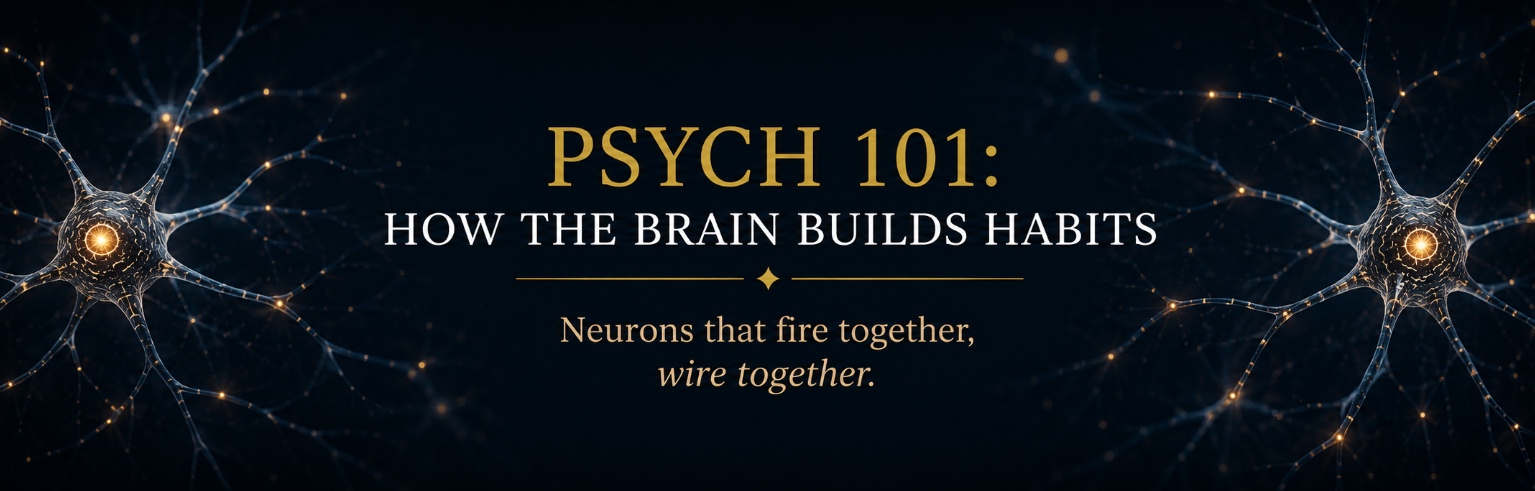
Your brain runs on networks of neurons. Neurons don’t work alone; they form interconnected pathways that fire together to produce thoughts, emotions, and behaviors. When you think a thought, feel an emotion, or take an action, a specific group of neurons activates in a specific pattern. That same pattern tends to repeat itself when the situation feels familiar.
Here’s the key idea: neurons that fire together, wire together.
The more often a particular pathway is used, the stronger and faster it becomes. Over time, the brain prefers the most efficient route. What started as a deliberate thought or behavior gradually turns into an automatic one. This is how habits form. This is also how automatic thoughts form, whether helpful or harmful.
If you repeatedly respond to stress with self-criticism, avoidance, or anger, those neural pathways get reinforced. Eventually, your brain doesn’t wait for permission. The response just shows up. It feels instant, reflexive, and out of your control, but it isn’t random. It’s well practiced.
The same rule applies in the other direction. Repeatedly practicing emotional regulation, self-compassion, problem-solving, or assertive communication strengthens those pathways too. With enough repetition, healthier responses start to feel more natural and less forced.
Your brain is not biased toward happiness or suffering. It’s biased toward efficiency.
Why Old Patterns Come Back Under Stress
People often get frustrated when they feel like they’ve “regressed” during periods of stress. They’ve done the work. They know better. And yet, old reactions suddenly reappear.
This isn’t failure. It’s neurobiology.
Under stress, the brain prioritizes speed over nuance. Well-worn neural pathways, especially those built during emotionally charged experiences, are faster and more accessible than newer ones. When cognitive resources are taxed, the brain defaults to what it knows best, not what is healthiest.
Think of it like a trail system. New pathways are narrower and require intention to use. Old ones are wide, paved, and easy to fall back into, especially when visibility is low. Stress lowers visibility.
This is why change requires patience. The goal isn’t to eliminate old pathways; it’s to build new ones strong enough that they remain available even when life applies pressure.
When the Brain Is Most Changeable
The brain isn’t equally plastic at all times. Certain conditions make learning and change more effective.
Sleep plays a critical role. During sleep, the brain consolidates learning, strengthens useful connections, and prunes inefficient ones. Poor sleep doesn’t just affect mood, it interferes with your brain’s ability to rewire itself.
Emotion matters too. Moderate emotional engagement enhances learning. This is why experiences tied to meaning or relevance tend to stick, while neutral information fades quickly. Therapy works best when insights are emotionally felt, not just intellectually understood.
Repetition and timing also matter. Brief, consistent practice beats occasional intensity. Small, repeated choices, made close in time to the triggering situation, are what gradually reshape neural pathways.
The Exercise Analogy, Revisited
If you want to be physically fit, you don’t work out once and call it done. Strength, endurance, and flexibility only exist as long as they are maintained. When exercise stops, muscles weaken, stamina drops, and the body slowly returns to its default state. No moral failure involved; just biology.
Psychological fitness works the same way.
Coping skills, emotional regulation, and healthy thinking patterns are not traits you either have or don’t have. They are skills that require repetition. Practicing them builds neural strength. Neglecting them allows old pathways to regain dominance.
This is why insight alone rarely creates lasting change. Understanding why you react a certain way doesn’t automatically rewire the brain. Change happens through repetition, choosing different thoughts, behaviors, and responses often enough that new pathways become the brain’s preferred route.
What This Means for Therapy and Daily Life
Therapy is not about erasing parts of yourself or achieving constant emotional balance. It’s about training your brain to respond differently over time.
Progress often looks unremarkable in the moment. It shows up as slightly shorter emotional spirals, a quicker recovery after conflict, or a pause before reacting where there used to be none. These small shifts are signs that new neural pathways are being used.
Mental health, like physical health, is a process, not a finish line.
You don’t stay in psychological shape because you once learned coping skills. You stay in shape because you continue to practice them, especially when life gets hard. The work isn’t about perfection. It’s about consistency.
The brain is always adapting. The question isn’t whether it’s changing, it’s what you’re training it to become good at.